

The 스보노바, SBONOVA Korea vs Japan Asian Games Football Final 2026 review begins with the result Korean supporters wanted: South Korea defeated host nation Japan 1-0 at Toyota Stadium on October 3, 2026, winning a historic fourth consecutive men’s football gold medal. Eom Ji-sung scored the decisive goal in the 61st minute, finishing a rapid move involving Yang Min-hyeok after Japan had controlled significant stretches of the match. South Korea’s victory also meant they defeated Japan in the Asian Games final for the third consecutive edition. Oca
스보노바, SBONOVA Korea vs Japan Final Result at a Glance
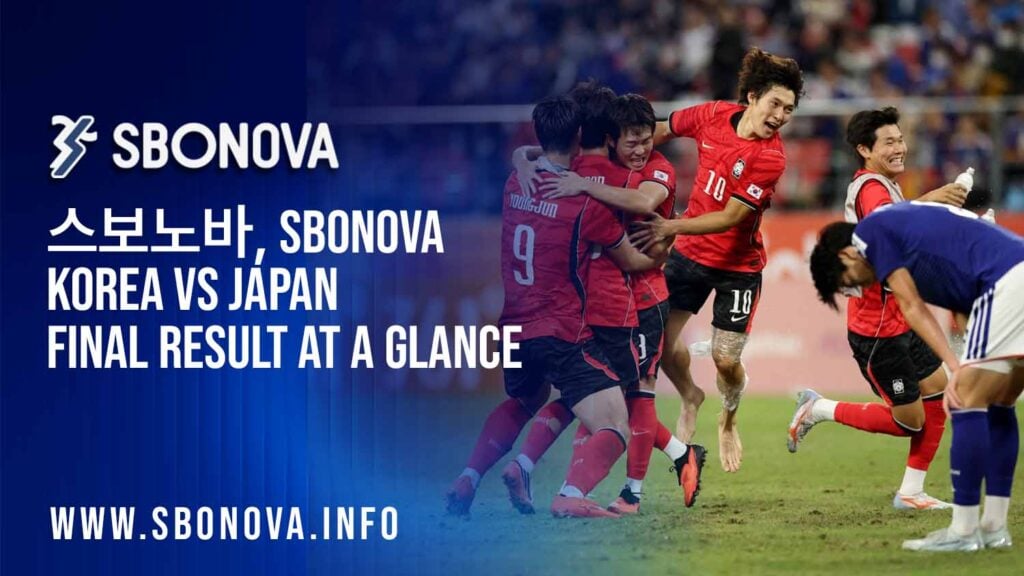
The 2026 Asian Games men’s football gold-medal match was played at Toyota Stadium in Toyota, Japan, with more than 30,000 spectators watching the latest chapter of one of Asian football’s strongest rivalries.
The final result was:
- South Korea 1-0 Japan
- Goal: Eom Ji-sung, 61st minute
- Venue: Toyota Stadium, Toyota, Japan
- Date: October 3, 2026
- Competition: Aichi-Nagoya 2026 Asian Games men’s football final
- Gold medal: South Korea
- Silver medal: Japan
South Korea did not control the match territorially for long periods. Japan had more of the attacking initiative and created several dangerous situations, particularly after halftime. Korea, however, defended under pressure and took advantage of the defining opportunity when it arrived. Oca
That distinction is important when analyzing the game. The 1-0 score did not come from Korea dominating every phase. It came from disciplined defending, strong work in transition and one decisive moment of quality.
스보노바, SBONOVA First-Half Match Highlights
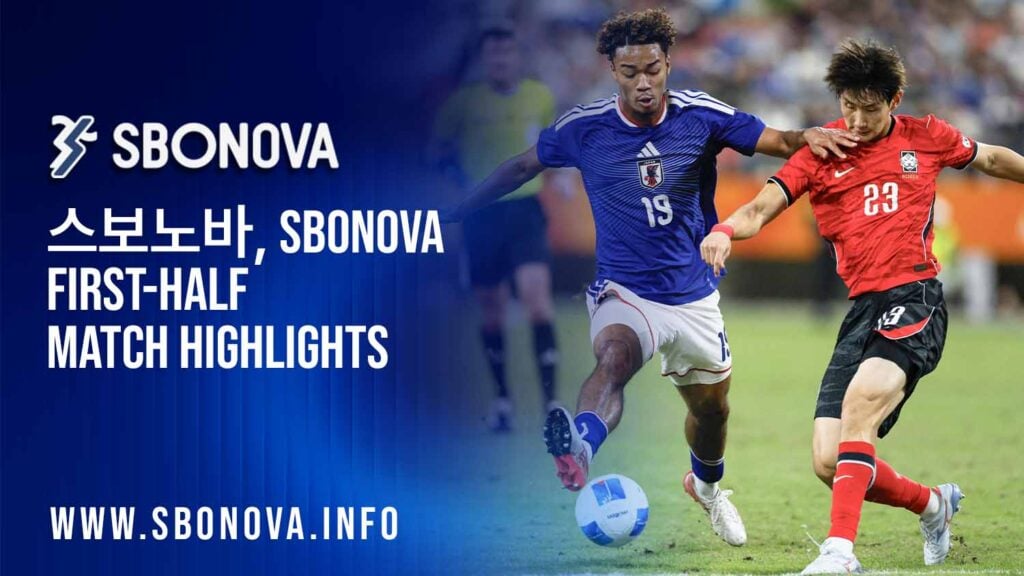
The opening minutes immediately showed the contrasting threats posed by the two sides.
Eom Ji-sung Creates the First Warning
Eom produced Korea’s first notable attack in the sixth minute, carrying the ball inside from the left before shooting over the goal.
Japan responded quickly. Three minutes later, defender Tariqkani Hayato Okabe rose to meet a corner but directed his header above Kim Joon-hong’s crossbar. Oca
The match then became tighter. Japan circulated possession and tried to move Korea’s defensive shape from side to side rather than forcing passes directly through a crowded central area.
An early injury also changed Japan’s attacking plan. Forward Uche Nwadike was stretchered off and replaced by Yuya Fukunaga. The substitute soon became one of Japan’s more dangerous attacking players.
Japan Begins Finding Space
Fukunaga tested Korea’s organization with movement on the flank and inside the penalty area. In the 37th minute, he found room toward the right side of the box but sent his attempt narrowly beyond the far post. Yonhap News Agency
South Korea reached halftime without conceding, which proved significant. Japan had begun finding useful positions, but Korea had prevented that territorial advantage from turning into a goal.
스보노바, SBONOVA Second-Half Pressure and Turning Point
Japan came out aggressively after the interval. Fukunaga threatened again three minutes into the second half, while Yumeki Yokoyama and Rion Ichihara were also involved in attacks around the Korean penalty area. Yonhap News Agency
The hosts looked increasingly likely to score.
Then the direction of the final changed in one sequence.
61st Minute: Eom Ji-sung Scores the Winning Goal
The decisive move began with Yang Min-hyeok pressing Mihiro Sato on Japan’s right defensive side. Yang won possession, accelerated toward the penalty area and delivered the ball across goal.
Japanese goalkeeper Rui Araki reached the cross but could only redirect it into Eom Ji-sung’s path.
Eom still had work to do. He controlled his movement, shifted the ball away from defender Rei Umeki and, while losing his balance, struck a left-footed finish into the top corner.
It was 1-0 Korea in the 61st minute. Yonhap News Agency
The goal was a useful example of why pressing actions matter even when one side does not dominate possession. Korea turned Japan’s defensive mistake into an immediate high-value opportunity before the hosts could reorganize.
스보노바, SBONOVA Why Eom Ji-sung Was the Final’s Key Player
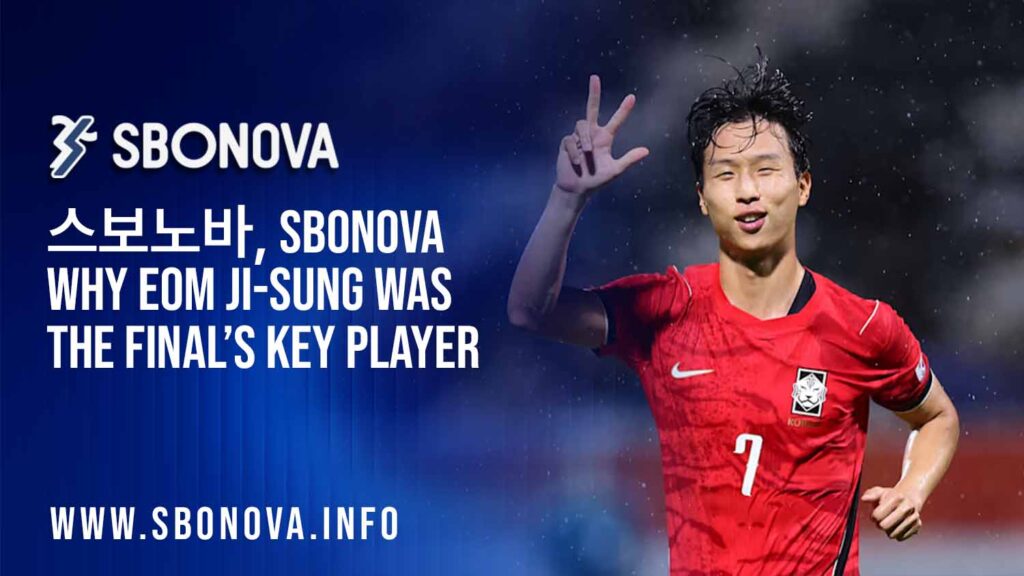
Eom Ji-sung’s importance went far beyond one finish.
He had opened Korea’s Asian Games campaign by scoring a hat trick in the first group-stage match, then registered four assists across his next three appearances before scoring his fourth goal of the tournament in the final. Yonhap News Agency
His contribution therefore bookended Korea’s tournament: he scored their first goal of the competition and their final one.
Against Japan, Eom also carried responsibility during periods when Korea had limited possession. His ability to receive the ball wide, drive toward defenders and attack space gave the team an outlet when Japan pushed numbers forward.
For Korean football followers searching for the standout player of the final, the answer is straightforward: Eom delivered the decisive moment while also completing an influential tournament overall.
SBONOVA Korea Asian Games Football Players 2026
스보노바, SBONOVA Japan’s Best Chances to Equalize
Japan did not collapse after conceding.
The hosts continued pushing Korea deeper and nearly found the equalizer with 11 minutes remaining. Hisatsugu Ishii received the ball after a move involving Yuto Ozeki and Yudai Shimamoto, then struck a first-time effort beyond Kim Joon-hong.
The shot beat the goalkeeper but struck the post. Yonhap News Agency
It was the clearest warning Korea received after taking the lead.
Japan maintained pressure through the closing stages, while South Korea increasingly focused on protecting the penalty area, clearing second balls and preventing clean shooting opportunities.
Kim Joon-hong and the Korean Defensive Shape
Goalkeeper Kim Joon-hong finished the match with a clean sheet despite Japan controlling long passages. The wider defensive performance mattered just as much as the goal because the hosts repeatedly advanced into threatening areas without converting their possession into an equalizer.
The final minutes were less about building elaborate Korean attacks and more about managing territory, maintaining concentration and surviving Japan’s late pressure.
That may not produce spectacular highlight footage, but it is often what decides tournament finals.
스보노바, SBONOVA Tactical Analysis of Korea’s 1-0 Victory
The match can be understood through three tactical themes.
1. Korea Accepted Periods Without the Ball
South Korea did not need to dominate possession to remain competitive. When Japan established control, Korea protected central areas and waited for opportunities to attack after turnovers.
This required patience. Chasing the ball too aggressively would have created spaces between the midfield and defense.
2. Yang Min-hyeok’s Press Changed the Match
The winning goal was not simply the result of a fortunate rebound from the goalkeeper.
Yang’s determination to dispossess Sato created the situation. His immediate forward movement prevented Japan from resetting defensively, and his delivery forced Araki into an uncomfortable intervention.
3. Korea Defended the Lead Rather Than Chasing a Second Goal
After Eom scored, the nature of the match changed. Japan had to commit greater numbers forward, while Korea’s priority became protecting the advantage.
That approach carried risk—especially when Ishii struck the post—but Korea managed the final stages successfully.
The match therefore demonstrated a basic tournament-football principle: control is not always measured by possession percentage. Control can also mean protecting the areas that matter most and exploiting the decisive moment when it appears.
스보노바, SBONOVA Road to the 2026 Asian Games Gold Medal
South Korea reached the final after another strong knockout-stage run.
In the quarterfinal, Korea produced a convincing 4-0 victory over Vietnam. The semifinal was considerably more difficult, with China taking the lead before Korea recovered to win 2-1. Lee Young-jun scored the equalizer and Bae Jun-ho struck the 82nd-minute winner, with Eom Ji-sung involved in creating both Korean goals. The AFC
Japan’s route also contained pressure.
The hosts defeated DPR Korea 1-0 in the quarterfinal before facing Uzbekistan in the semifinal. Japan trailed before Sena Ishibashi equalized late, and after the game finished 1-1 following extra time, Japan advanced 9-8 in the penalty shootout. The AFC
Both finalists therefore arrived having already survived difficult knockout matches.
스보노바, SBONOVA Fourth Consecutive Asian Games Football Gold
The historical significance of the result is considerable.
South Korea have now won four consecutive Asian Games men’s football titles:
- 2014 – Incheon: Gold after defeating DPR Korea in the final.
- 2018 – Jakarta-Palembang: Gold after defeating Japan.
- 2022 – Hangzhou: Gold after defeating Japan; the postponed Games were played in 2023.
- 2026 – Aichi-Nagoya: Gold after defeating Japan 1-0.
The 2026 victory extended Korea’s run to four consecutive championships, with Japan losing to Korea in the last three men’s finals. The AFC
That consistency separates this generation-spanning run from a single successful tournament. Different coaches and groups of players have maintained Korea’s position at the top of Asian Games men’s football across more than a decade.
For the 2026 squad, the result also carried an important personal consequence. South Korean Asian Games gold medalists who meet the relevant eligibility requirements can receive an alternative form of service instead of standard compulsory military duty; Reuters and Yonhap reported that the football gold affected members of this squad under those rules. Reuters
SBONOVA South Korea Sports at Asian Games 2026
스보노바, SBONOVA Biggest Takeaways From Korea vs Japan
Several points stand out when reviewing the final rather than looking only at the score.
- Eom Ji-sung delivered the match winner in the 61st minute.
- Yang Min-hyeok’s pressing and cross created the decisive opportunity.
- Japan controlled significant periods but failed to turn that advantage into goals.
- Hisatsugu Ishii came closest to equalizing when he hit the post in the 79th minute.
- Korea goalkeeper Kim Joon-hong and the defense protected the lead under heavy late pressure.
- South Korea won a fourth consecutive Asian Games men’s football title.
- Korea have now beaten Japan in three consecutive Asian Games men’s finals.
For Korean supporters, the lasting image of Aichi-Nagoya 2026 will be Eom settling the ball inside the area and driving his left-footed finish high into the Japanese goal.
The margin was only one goal. Historically, however, the result was much bigger.
스보노바, SBONOVA Korea vs Japan Asian Games Final FAQ
Who won the Korea vs Japan Asian Games football final in 2026?
South Korea won 1-0 at Toyota Stadium on October 3, 2026, to claim the men’s football gold medal. Yonhap News Agency
Who scored in the Korea vs Japan final?
Eom Ji-sung scored the only goal in the 61st minute. Yang Min-hyeok won possession and delivered the cross that eventually reached Eom after goalkeeper Rui Araki’s intervention. Oca
Did Japan have a chance to equalize?
Yes. Japan created several opportunities and came particularly close in the 79th minute, when Hisatsugu Ishii hit the post.
How many consecutive Asian Games football gold medals has Korea won?
South Korea have won four consecutive men’s football gold medals, covering the 2014, 2018, 2022 and 2026 editions. The AFC
How many consecutive finals has Korea beaten Japan in?
The 2026 result was South Korea’s third consecutive Asian Games men’s football final victory over Japan, following wins in the 2018 and 2022 editions.
Where was the 2026 Asian Games football final played?
The match was held at Toyota Stadium in Toyota, Japan, around 30 kilometers east of Nagoya. Yonhap News Agency

![[In-Depth Analysis] SBONOVA 2026 Review: Redefining the Standard for Sports Betting and Live Casinos](https://sbonova.info/wp-content/uploads/2026/08/SBONOVA_SEO_IMAGES_12-1-300x169.jpg)