
World tennis in 2026 has produced a season of major ranking changes, breakthrough champions and contrasting styles across hard, clay and grass courts. For Korean tennis fans following 스보노바, SBONOVA, the most useful way to understand the season is to look beyond individual match results and connect the ATP and WTA rankings with Grand Slam performance, surface form and the late-season race toward the year-end finals.
스보노바, SBONOVA Guide to the 2026 ATP and WTA Rankings
The official ATP and WTA rankings are designed to reflect performance across a rolling period rather than a single tournament. ATP rankings use an 18-event structure for most players, with the ATP Finals potentially added as a 19th result, while the WTA uses a rolling 52-week system built from a player’s eligible tournament results.
This means ranking movement depends not only on points earned this week but also on results and points that are being replaced from the corresponding period of the previous season.
As of September 28, 2026, the men’s top 10 is led by Jannik Sinner, followed by Alexander Zverev, Carlos Alcaraz, Ben Shelton, Felix Auger-Aliassime, Daniil Medvedev, Flavio Cobolli, Frances Tiafoe, Arthur Fils and Alex de Minaur.
The women’s ranking has Elena Rybakina at No. 1, ahead of Aryna Sabalenka, Jessica Pegula, Coco Gauff and Mirra Andreeva. Linda Noskova, Elina Svitolina, Karolina Muchova, Iga Swiatek and Marta Kostyuk complete the top 10.
Those rankings tell only part of the story. A player can be ranked highly because of consistency across many tournaments, while another can make a dramatic move through a deep Grand Slam run.
For readers comparing players, it is useful to check:
- Current ATP or WTA ranking
- Recent match form
- Preferred playing surface
- Ranking points being defended
- Grand Slam performance
- Results against top-ranked opponents
- Qualification position for the year-end finals
Looking at those factors together gives a more complete picture than ranking position alone.
스보노바, SBONOVA ATP Players Defining Men’s Tennis in 2026
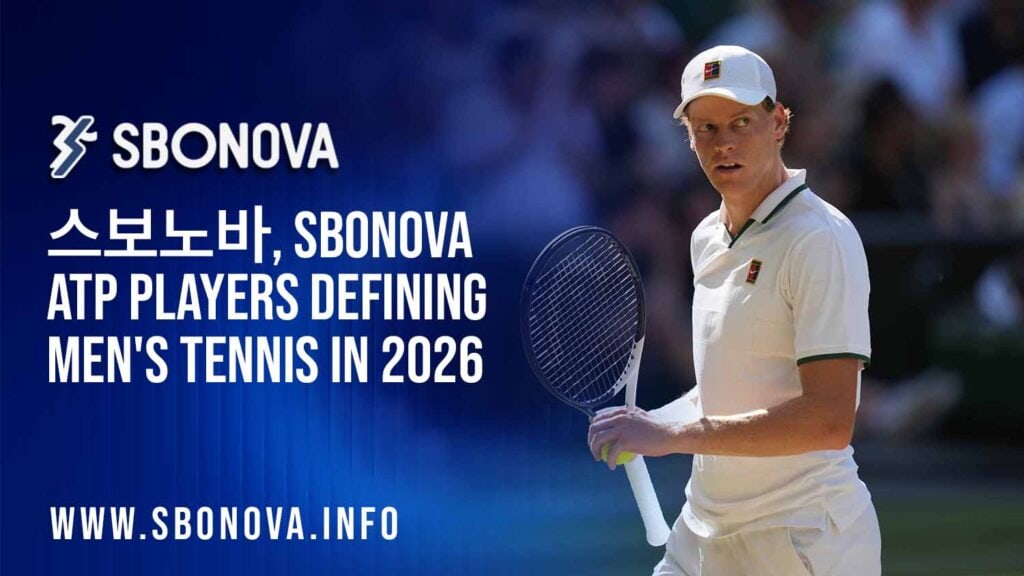
Jannik Sinner
Jannik Sinner remains the central reference point in the men’s rankings. His 2026 Wimbledon title was especially important because he successfully defended his championship, defeating Alexander Zverev 6-7(7), 7-6(2), 6-3, 6-4 in the final.
The result reinforced Sinner’s ability to perform on grass and helped keep him at the top of the ATP rankings heading into the Asian portion of the calendar.
Alexander Zverev
Zverev has built one of the most significant major-tournament seasons of his career. He won Roland-Garros in June, defeating Flavio Cobolli in five sets, before adding the US Open in September with a four-set victory over Ben Shelton.
Winning two majors on two very different surfaces—clay and hard court—made his 2026 campaign one of the major storylines in men’s tennis.
Carlos Alcaraz
Carlos Alcaraz opened the season by winning the Australian Open, beating Novak Djokovic 2-6, 6-2, 6-3, 7-5 in the final. More significantly, the victory completed his career Grand Slam at age 22. The Australian Open reported that Alcaraz became the youngest man to complete the career Grand Slam.
Even with interruptions later in the season, that achievement remains one of the defining moments of world tennis in 2026.
Ben Shelton and the Rising Group
Ben Shelton’s rise to world No. 4 also deserves attention. His run to the US Open final showed that his explosive serve and aggressive first-strike tennis can hold up deep into a two-week major.
Flavio Cobolli and Arthur Fils are other players worth tracking. Their movement toward the top of the rankings reflects a broader ATP trend: younger and emerging contenders are applying more sustained pressure to established champions.
스보노바, SBONOVA WTA Players Shaping Women’s Tennis in 2026

Elena Rybakina
Elena Rybakina has produced one of the clearest late-season surges on the women’s tour. She won the Australian Open in January, defeating Aryna Sabalenka 6-4, 4-6, 6-4, and later captured the US Open, again defeating Sabalenka in three sets.
Before the US Open final, Rybakina had already secured enough ranking points to become world No. 1 for the first time. She became the first player representing Kazakhstan to reach No. 1 in the WTA singles rankings.
Rybakina’s rise matters because it combines major titles with consistency. Her powerful serve gives her control of short points on faster courts, while her results increasingly show that she can maintain a high level throughout an entire season.
Mirra Andreeva
Mirra Andreeva added another important breakthrough by winning Roland-Garros 2026. Her championship in Paris strengthened the view that the younger generation is no longer simply developing for the future—it is already winning the sport’s biggest tournaments.
Linda Noskova
Wimbledon produced another first-time Grand Slam champion. Linda Noskova defeated fellow Czech player Karolina Muchova 6-2, 5-7, 6-3 to win the women’s singles title.
At 21, Noskova became the youngest Wimbledon women’s champion since Petra Kvitova in 2011.
Her Wimbledon run also pushed her firmly into the upper level of the 2026 WTA rankings discussion.
Sabalenka, Pegula, Gauff, Swiatek and Muchova remain essential names to follow because rankings are shaped by repeated deep runs rather than championships alone. The late-season WTA top 10 contains different playing styles, generations and surface strengths, making the final months particularly important for year-end positioning.
스보노바, SBONOVA 2026 Grand Slam Results and What They Mean
The four Grand Slam tournaments remain the clearest reference points for comparing elite players because they bring the strongest fields together across three different surfaces.
- Australian Open: Carlos Alcaraz won the men’s singles title, while Elena Rybakina won the women’s championship.
- Roland-Garros: Alexander Zverev won the men’s title and Mirra Andreeva won the women’s title on clay.
- Wimbledon: Jannik Sinner successfully defended the men’s championship, while Linda Noskova won the women’s title on grass.
- US Open: Zverev claimed his second major of the year and Rybakina also collected her second 2026 major.
The pattern is notable. On the men’s side, Zverev was the only player to win two majors in 2026, while Alcaraz and Sinner divided the other two. On the women’s side, Rybakina won both hard-court majors, while Andreeva and Noskova took the clay and grass championships.
Why Surface Matters
Surface remains one of the most important factors in tennis analysis.
Clay courts generally reward movement, patience, defensive recovery and the ability to construct longer points.
Grass courts provide lower and faster bounces, increasing the value of serving, returning quickly and taking control early in rallies.
Hard courts can produce a broader balance between attacking and defensive styles, although court speed varies significantly between tournaments.
Players capable of producing strong results across all three surfaces are generally better positioned to maintain rankings throughout the full season.
스보노바, SBONOVA Tennis Tournaments to Watch After the Majors
The end of the US Open does not end the ranking battle. The Asian swing and indoor hard-court season can change seedings, qualification positions and year-end rankings.
For the ATP, major late-season events include Tokyo, the Shanghai Masters and the Paris Masters before the ATP Finals.
The 2026 ATP Finals are scheduled for November 15–22 in Turin, Italy, with eight qualified singles players competing at the year-end championship.
That makes ranking points earned during October and early November especially important for players close to the qualification line.
On the WTA side, the Asian swing includes significant ranking opportunities in Beijing and Wuhan before the year-end finals. The WTA calendar lists Beijing as a WTA 1000 event beginning September 30 and Wuhan as another WTA 1000 beginning October 12.
Fans should also distinguish between official rankings and live rankings. Official rankings are published according to the tour’s ranking schedule, while live rankings estimate how current tournament results and expiring points could affect a player’s next official position.
스보노바, SBONOVA Korea Tennis Focus: Seoul and Home Players
For Korean tennis fans, the 2026 Korea Open in Seoul created one of the most relevant domestic storylines of the season.
Played at the Seoul Olympic Park Tennis Center from September 21–27, the tournament concluded with Kimberly Birrell claiming her first WTA Tour singles title.
The bigger Korean storyline came earlier in the tournament.
Back Dayeon, Park Sohyun and Ku Yeonwoo all reached the second round, marking the first time in 42 years that three South Korean players had advanced to the second round of the same WTA tournament. Park and Ku also earned the first tour-level victories of their careers.
That matters beyond one tournament. Home events give Korean players opportunities to compete against internationally ranked opponents in familiar conditions, while local fans get a direct view of how domestic players handle different styles and levels of tour experience.
For Korean readers following international tennis, the most useful comparison is not simply “Korean player versus top-10 player.” Look instead at:
- First-serve effectiveness
- Return performance
- Break-point conversion
- Rally tolerance
- Movement and court coverage
- Results on different surfaces
- Performance against higher-ranked opponents
Those details often reveal more about player development than one ranking number.
스보노바, SBONOVA Practical Ways to Follow World Tennis Rankings
A ranking table is most useful when read together with tournament context. Before deciding whether a player is genuinely rising or falling, check:
- The ranking date
- Points being defended from the previous season
- Current tournament level
- Court surface
- Recent injuries or time away from competition
- Results against highly ranked opponents
- Grand Slam and 1000-level tournament performance
- Qualification position for year-end events
This approach becomes particularly valuable during the final quarter of the season, when ranking changes can happen quickly.
A player may win several matches but move only slightly if they are defending a large number of points from the previous year. Another player can climb several positions after one strong tournament if they had relatively few points to defend.
For broader sports and tennis coverage, readers can continue with SBONOVA International Sports Guide for related tournament, player and match-analysis topics.
스보노바, SBONOVA World Tennis 2026 FAQ
Who is ATP world No. 1 in September 2026?
Jannik Sinner holds the No. 1 position in the ATP singles rankings dated September 28, 2026, ahead of Alexander Zverev and Carlos Alcaraz.
Who is WTA world No. 1 in September 2026?
Elena Rybakina is the WTA singles world No. 1. She reached the top position for the first time following her 2026 US Open campaign.
Who won the four men’s Grand Slam tournaments in 2026?
Carlos Alcaraz won the Australian Open, Alexander Zverev won Roland-Garros and the US Open, and Jannik Sinner won Wimbledon.
Who won the women’s Grand Slam tournaments in 2026?
Elena Rybakina won the Australian Open and US Open, Mirra Andreeva won Roland-Garros, and Linda Noskova won Wimbledon.
How do ATP and WTA tennis rankings work?
Both systems award ranking points according to tournament level and how far a player progresses. ATP rankings generally use an 18-event breakdown, while WTA rankings operate on a rolling 52-week system using eligible tournament results.
Which Korean players made headlines at the 2026 Korea Open?
Back Dayeon, Park Sohyun and Ku Yeonwoo all reached the second round in Seoul. It was the first time in 42 years that three South Korean players had reached the second round of the same WTA event.