
스보노바 (SBONOVA) blackjack players usually need three things first: clear rules, correct card values, and a practical way to decide when to hit, stand, double down or split. Blackjack is easy to learn, but the right decision can change with the table rules. This guide covers the core game and beginner-friendly basic strategy without assuming every table works the same way.

SBONOVA Blackjack Rules: How the Game Works
The goal of blackjack is to finish with a stronger hand than the dealer without going over 21. You do not need exactly 21 to win; a total of 18 can beat a dealer total of 17.
Players normally start with two cards. The dealer also receives cards, with at least one visible. This visible card is known as the dealer’s upcard, and it is the main reference for blackjack basic-strategy decisions.
A natural blackjack is an Ace plus a 10, Jack, Queen or King on the first two cards. A three-card 21 is still a total of 21, but it is not normally treated as a natural blackjack.
If the player and dealer finish with the same qualifying total, the result is usually a push, subject to the table’s specific rules.
Before playing, check the game information panel so you know the exact conditions being used.
[Internal Link: SBONOVA Casino Games Guide]
SBONOVA Blackjack Card Values
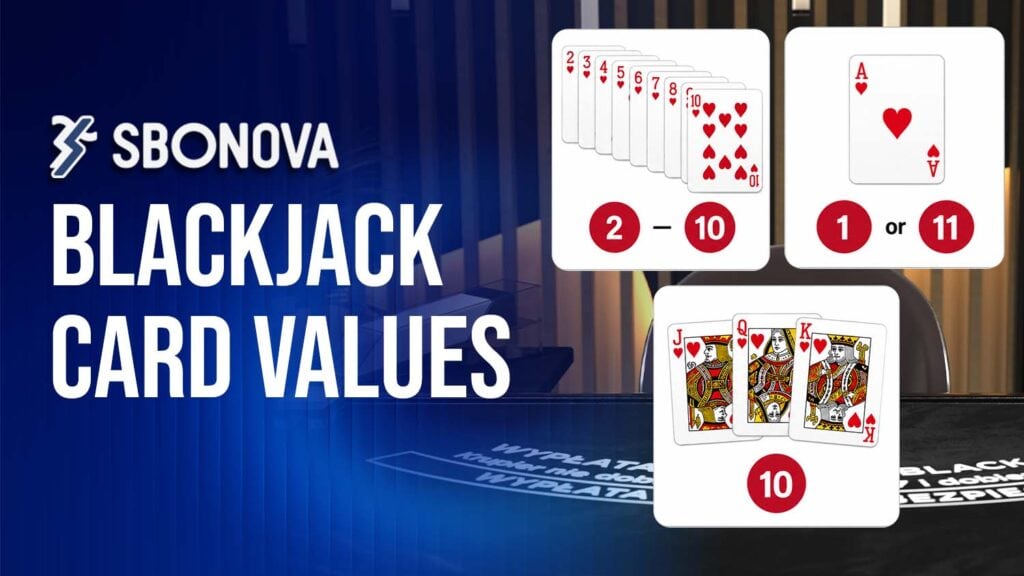
Understanding SBONOVA Blackjack card values takes only a few minutes:
- Cards 2–10 are worth their printed number.
- Jack, Queen and King are each worth 10.
- An Ace can count as either 1 or 11, whichever keeps the hand legal and produces the stronger total.
An Ace creates a soft hand when it can still count as 11. Ace-6, for example, is called soft 17 because it can be counted as either 7 or 17.
A hand with no Ace currently counted as 11 is known as a hard hand.
Knowing the difference between hard and soft totals matters because two hands showing similar totals may require different blackjack strategy decisions.
Hit, Stand, Double Down and Split
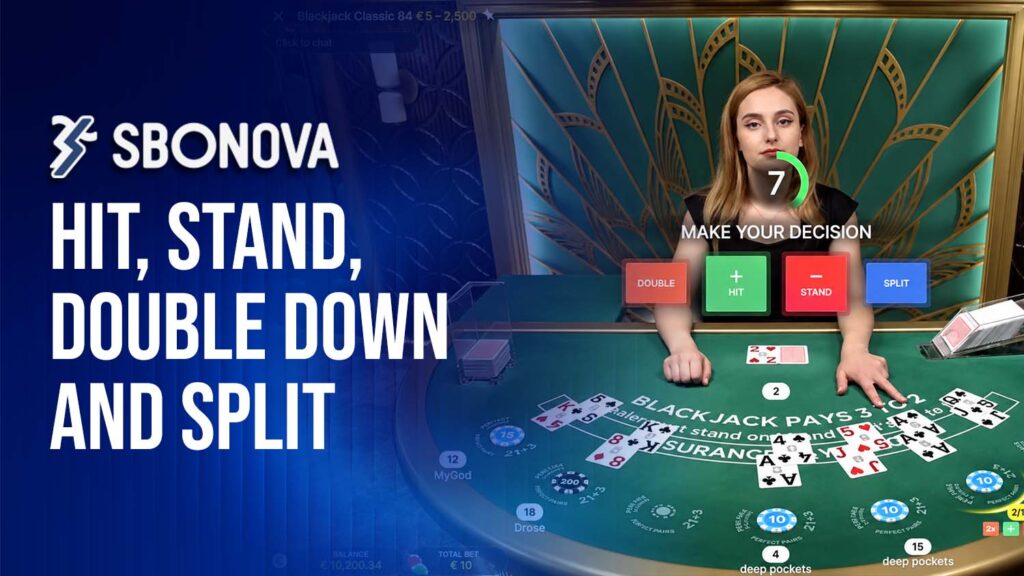
Most blackjack hands involve four main player actions.
Hit
Choose hit to receive another card. Going above 21 causes the hand to bust and lose.
Stand
Choose stand when you want to keep your current total and receive no more cards.
Double Down
A double down increases the original wager, gives the player one additional card and then ends the player’s action for that hand.
The exact hands eligible for doubling vary between blackjack tables.
Split
When your first two cards form an eligible pair, the rules may allow you to split them into two separate hands by adding another wager.
Re-splitting rules and special conditions for split Aces can vary, so check the game’s rule information.
Dealer Rules and Soft 17
Unlike the player, the blackjack dealer follows predetermined rules. Dealers normally continue drawing below 17, but one important table condition is whether the dealer hits or stands on soft 17.
This distinction matters because it can change several blackjack basic-strategy decisions.
Players should also check:
- Number of decks
- Blackjack payout
- Surrender availability
- Double-down restrictions
- Double after split rules
- Re-splitting conditions
A blackjack strategy chart should therefore match the exact rule set rather than simply matching the appearance of the table.
SBONOVA Blackjack Basic Strategy for Beginners
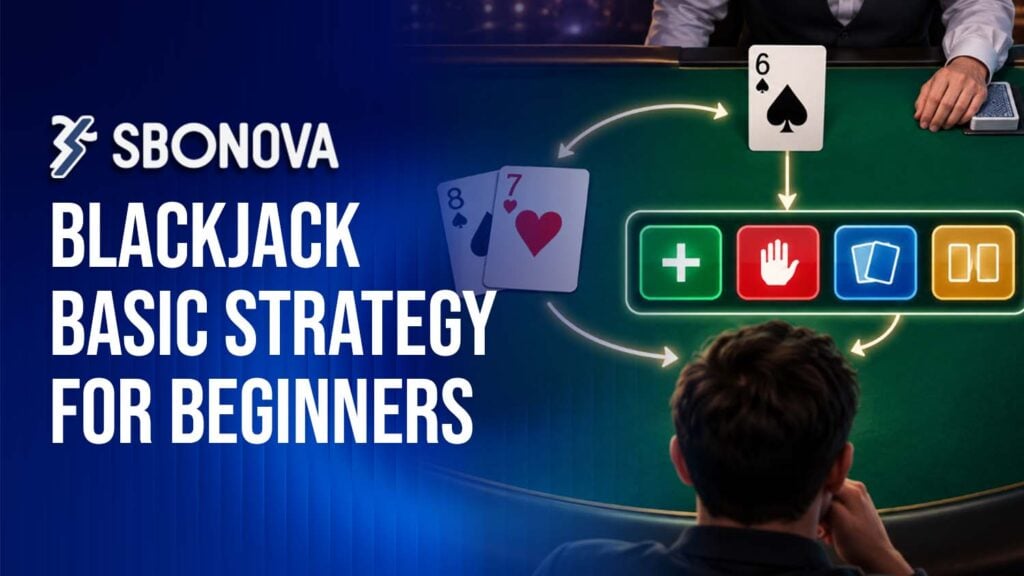
SBONOVA Blackjack basic strategy uses your hand and the dealer’s upcard to select the mathematically strongest available action.
It cannot predict which card will appear next, and it does not guarantee that an individual hand or playing session will win.
For a common multi-deck blackjack game, these guidelines provide a useful beginner baseline:
- Hard 8 or lower: generally hit.
- Hard 17 or higher: generally stand.
- Hard 12: commonly stand against dealer 4–6; hit against 2–3 or 7 through Ace.
- Hard 13–16: commonly stand against dealer 2–6; hit against 7 through Ace.
- Hard 9: commonly double against 3–6 when allowed; otherwise hit.
- Hard 10: commonly double against 2–9 when allowed; hit against 10 or Ace.
- Hard 11: often doubles against many dealer cards, although the Ace decision can change depending on the soft-17 rule.
- Pair of Aces: commonly split.
- Pair of 8s: commonly split.
- Pair of 10s: normally stand rather than split.
- Pair of 5s: usually play as a hard 10 instead of splitting.
These are useful memory rules, not a universal blackjack chart.
For precise decisions, use a blackjack basic strategy chart designed for the number of decks and exact dealer, doubling, surrender and splitting rules being used.
SBONOVA Blackjack Table Rules to Check Before Playing
Two online blackjack tables can look almost identical while using different conditions.
Before placing a wager, check:
- Blackjack payout — for example, 3:2 or another rate.
- Dealer soft 17 rule — hit or stand.
- Number of decks.
- Double-down restrictions.
- Double after split — allowed or unavailable.
- Re-splitting rules, particularly for Aces.
- Surrender — available or unavailable.
A 3:2 blackjack payout is different from a 6:5 payout, and other rule variations can also affect the game’s expected return.
Reading the table information is therefore more useful than assuming every blackjack game follows identical rules.
Common SBONOVA Blackjack Mistakes
A common beginner mistake is treating every total of 21 as a natural blackjack. Remember that a blackjack normally refers specifically to the qualifying two-card combination.
Another mistake is following a blackjack strategy chart without checking whether it matches the actual table rules.
Players may also:
- Split 10s unnecessarily
- Take insurance automatically
- Ignore the dealer’s upcard
- Confuse hard and soft hands
- Change strategy because of a recent winning or losing streak
Basic strategy focuses on the current player hand, dealer upcard and table rules, not on the belief that a certain card is “due.”
Good strategy also does not remove gambling risk. Set a spending limit before playing and avoid increasing wagers simply to recover previous losses.
Playing Blackjack on SBONOVA Mobile APP

The mathematics behind blackjack does not change because you are playing on a mobile device, but the interface may be different.
Check your selected chip value, table limits and action button before confirming a move. On a smaller screen, it is especially useful to make sure you are selecting the intended hit, stand, double or split command.
If you are still learning, keep a rules-specific basic strategy reference nearby.
Quick SBONOVA Blackjack Checklist
Before making a decision, ask yourself:
- What is my hand total?
- Is my hand hard or soft?
- What is the dealer’s upcard?
- Which actions are permitted?
- Which basic-strategy decision matches these rules?
Learning blackjack does not require memorizing every possible combination immediately.
Start with blackjack card values, learn the basic hit-or-stand decisions, and then move on to doubling, pair splitting and rule-specific exceptions.